
A talking companion for supported living
A talking companion for supported living, and a calmer front desk where people with disability go for care. Talk or tap, in plain words.
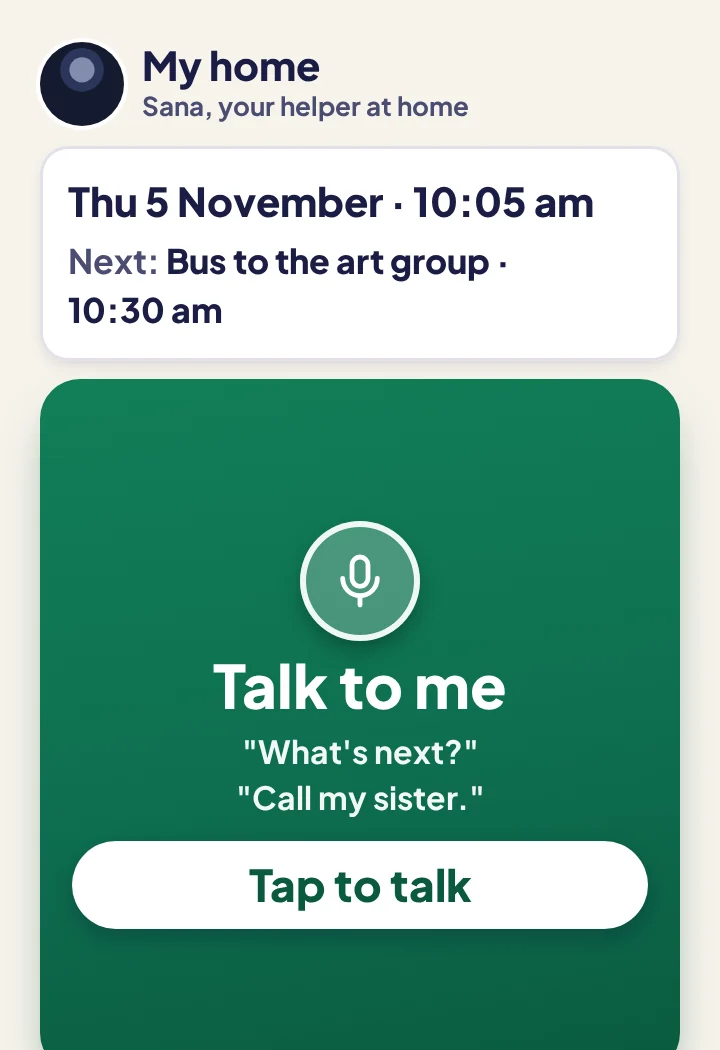
Two places, one system
At home and in SIL
Each person’s routine in their own words, calls after a yes, and “Help me” on every screen. See how it works.
It isn’t an emergency service. In an emergency, call 000.
At the medical centre
Questions answered at the kiosk and a call when the doctor is ready, so nobody has to sit in a busy room. See how it works.
Designed for everyone who uses it
Everyday information is often locked behind fast talk and small print. The companion slows it down.
- Talk or tap, whichever is easier.
- Short sentences, one question at a time.
- “Again” repeats the last answer word for word.
- Large type, high contrast and big touch targets.
- Warm and adult. Never childish.
Daily living, not medical
Purpose
Every feature is about daily living, staying in touch and communication. It makes no medical claims and names no conditions.
Co-design
Your participants, speech pathologists and support staff know what works. We’d like to build the next version with them.
What it’s designed not to do
- Give health or medication advice. Health questions go to the support person.
- Name or guess at a condition or diagnosis.
- Replace support workers. It answers the everyday questions so support hours go to support.
In a build, we’d set up the day’s routine with the person and the people who support them, in their own words. What a build keeps, who sees it and where it lives go in its spec, agreed before anything goes in.
Try it with your team
A short demo, set up for supported living.